by Lufthansa Flyer | Jan 21, 2016 | Featured, Fleet Update, Lufthansa |
After a few minor delays and a change in delivery order, Lufthansa was finally able to announce that it took delivery of their first A320neo aircraft. The ‘NEO’ or new engine option is an a320 model that promises better efficiencies thanks to new engines that have been developed for the bird.
Originally, Qatar was to be the first to take delivery of the NEO but they deferred when Airbus could not resolve a few minor engine issues to the satisfaction of Qatar. LUFTHANSA stepped in to the launch customer position after Technik engineers felt that the engine issues were easy to resolve within a short time frame. LH was to have taken delivery of the NEO late in December 2015 but Airbus delayed the delivery by another 3 weeks.
So what led to the delay?
The biggest obstacle that led to the minor delivery delay had to do with the Pratt and Whitney PW1100G engines that are powering some of these new NEOs. Due to the original design, the engine requires a several minute warm up at idle before thrust could be applied. Though this is not a safety issue for the engine when it is operated properly, it did cause a delay with regulators that were certifying the aircraft. Due to the engine needing the warm up period, the steps and processes to properly bring an engine to operating temperature had to be documented in the engine’s manuals as well as the checklist used by the cockpit crew when preparing the aircraft for departure.
As with any government agency, there is bureaucracy, and with bureaucracy comes delays. It was these ‘paper delays’ by Pratt and Whitney and the regulators that led to the bulk of the delivery delay of the aircraft. With all that behind Airbus and Lufthansa, we can look forward to the new birds showing up over the next several months.
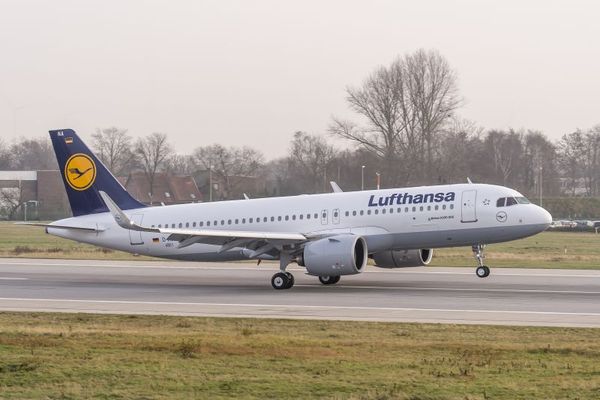
The new A320neo. Photo courtesy of Lufthansa.
This first NEO, D-AINA, is now in Hamburg at LH Technik facilities where it is being prepared to enter service. If all goes to plan, D-AINA will be transferred to Frankfurt on January 24 and will enter service at that point. She will initially fly between Frankfurt, Hamburg, and Munich.
The NEO promises to increase fuel efficiencies by approximately 15 percent while reducing external noise levels by 50% compare to the current A320 model. The new aircraft also comes with Sharklets installed on the wing tips which further enhance the aircraft’s performance and handling. Unfortunately with the cratering of oil and fuel costs, the cost/benefit ratio of the airplane is not as good as it once was, but nevertheless we’ll have new airplanes to enjoy for a long time to come. At least the fleet will be more efficient by the next time fuel prices skyrocket.
LH has 116 A32x NEOs coming to the fleet. 45 of of them will be A321s while the rest of them will be A320s. Five A320s will delivered to LH in 2016 and will all be based in Frankfurt. These airplanes are destined to replace the current and less efficient A320 and A321s in the fleet.

by Lufthansa Flyer | Jan 17, 2016 | Fare Sale, Featured, LCC, Lufthansa, Premium Economy |
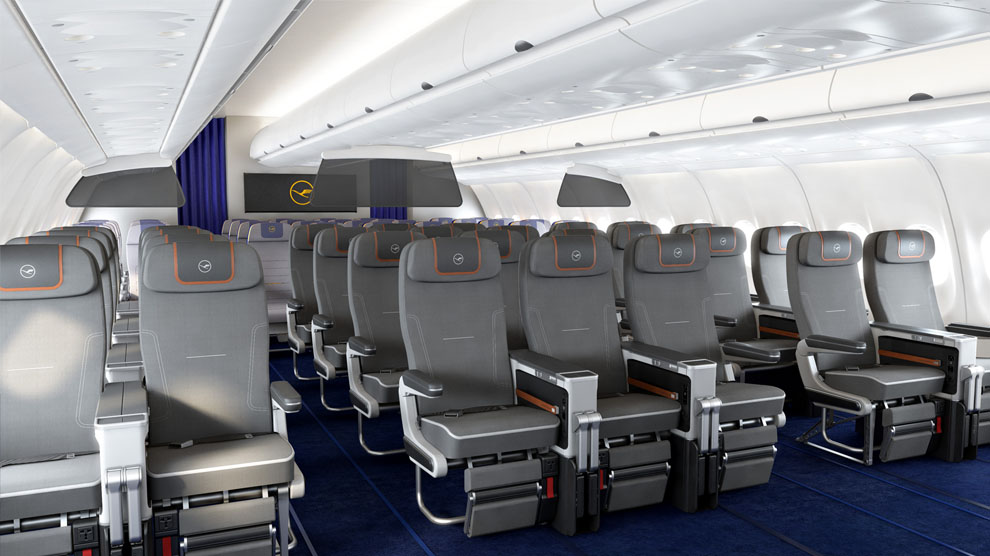
Lufthansa’s Premium Economy fare sale between the USA and Europe has some attractive deals that are available for booking until the end of the month. One of the best offers is between Tampa Bay and St. Petersburg (Russia) for only $959. Granted that this is operated through their ‘JUMP’ LCC concept, but the seat and cabin is identical to the mainline version.
Otherwise, most of LH’s destinations in Europe can be reached from the East Coast in the $1,100 – $1,400 range while fares from the Midwest and West Coast start in the mid $1,500 area and work their way up to $1780 for departures from Houston and San Francisco. These sale fares are booking into ‘N’ class so you’ll earn 100% of miles flown for your Miles & More account.
The fine print:
Fare sale ends on January 29, 2016
Departures must take place between January 31 and March 17, 2016.
Return travel must take place between January 31 and June 30, 2016.
Maximum stay of 3 months.
Tickets must be purchased 14 days ahead of departure date.
Need to figure how which seat to choose? Refer to this post that covers the Premium Economy Seating Charts for the fleet.


by Lufthansa Flyer | Jan 15, 2016 | Featured, Lufthansa, On Board Experience, Passenger Experience |
Later this month, Lufthansa is set to unveil their latest digital innovation when they launch ‘eJournal’ for their passengers.
Beginning Thursday, January 21, eJournal will allow passengers to use their ‘Smart’ devices to download newspapers, magazines and other digital content so that they can be enjoyed during flight. This will also mark the beginning of the end of print material that will be available on board for most flights (more on that later).
eJournal is designed to be fairly simply to use. Passengers simply need to visit www.LH.com/eJournals within 3 days of their scheduled departure in order to select the content they wish to download. You’ll need to your ticket number or PNR code in ‘log in’ to eJournal. Initially passengers will be allowed to download two ‘pieces’ of content. Once the content is downloaded it will be available for you to use even after your flight.
According to LH, the program will expand in March when they plan to add additional content and to increase the amount of downloads that passengers can make from eJournal. It looks like LH will provide additional eJournal benefits for passengers traveling in premium cabins as well as for passengers who have certain status levels within Miles & More beginning in March as well. There is also talk of premium eJournal content being made available for a fee but nothing has been decided as yet.
I mentioned earlier that this marks the beginning of the phase-out of print material on board LH flights. For now, Lufthansa will keep printed material available in First and Business Class cabins, in all lounges and for flights leaving major airports in Germany including Berlin, Hamburg, Dusseldorf, Frankfurt, Munich, and Stuttgart.


by Lufthansa Flyer | Jan 13, 2016 | Airports, Featured, Munich, Passenger Experience |
Earlier this week, Munich Aiport opened the doors to its new Satellite Terminal 2 and invited experienced travelers to put the new building through several simulations to make sure systems, signage and technology was working properly. This was done in coordination with Lufthansa who also had their employees there to make sure their systems are working as well.
A friend of mine, FlyerTalk and VFT’s ‘ClaudiSTR’, happened to be one of the lucky few that had a chance to walk the terminal. She was asked to play the role of a passenger in several different capacities throughout the day. As you’ll read in her review, you’ll see that she ‘flew’ First Class on several flights and had earned approximately 144,000 status miles and was well on her way to becoming a HON Circle member after having such a busy day.
From what Claudi has to say, it looks like the new terminal is on track for a smooth opening later this year. A few more systems are left to test and a few aesthetic construction projects need to be completed, but it looks like we’ll have a winner with ‘ST2’.
You’ll notice that there are no photos that accompany Claudi’s write-up. This is because there was no photography allowed during the testing. Sorry.
Without further ado, here is Claudi’s look at the new Terminal:
HON in one day or the first day of trial operations of the new satellite of T2 at Munich Airport
Gorgeous! In just one day I flew YVR-MUC-BOM, DXB-MUC-SSJ, ARN-MUC-HND and MEX-MUC-CDG, learned about several gates of the new satellite at Munich airport and was allowed to run around in the satellite and was seeing everything.
Yes, looking was possible, taking pictures impossible. This report has to get along without photos because photography was not allowed just like smoking.
The day started at 10 am with registration of the participants in this trial operations day in a dedicated room at T2. All participants were given a green vest and we were divided into 8 groups. 105 participants enrolled for today, round about 95-100 appeared.
Water, coffee and tea were available. Meanwhile, our coordinator (red vest) told us, how we are going to test during the day. Today we were supposed to test the flight connections, the signage and signs and should detect the ways of making a connection. We would arrive from Vancouver (YVR) and connect either to Mumbai (BOM), Frankfurt (FRA) or Paris (CDG).
This was followed by a safety briefing, because the satellite is still under construction. The opening is planned for April 2016 and they are currently working on interior construction.
We took buses to drive directly to the satellite, because the Person Transport System (PTS) has not yet been approved by the building authorities. At present, the English operating papers are translated by the manufacturer Bombardier and then they will be approved hopefully soon.The PTS will have three sections, which are sure to be very interesting for testing (Schengen, non-Schengen clean, non-Schengen unclean).
In general, this is the data of the satellite:
– The building is about 630 m long (T2 compared 930 m) and up to 250 m wide
– K-Gates: Schengen gates, level 04
– L-Gates: Non-Schengen gates (clean), Level 05
– M-Gates: Incoming non-clean Non-Schengen gates, level 06, top Level of building with good views
– The gate numbers count from north to south, beginning with 01 and ending with 30. In the East, even numbers, in the West the odd numbers.
– Bus gates shouldn’t be at the satellite. The airport and Lufthansa hope to be able to handle all flights with the opening of the satellite from flightbridges. Nevertheless, there are still 6 J-Gates that would be suitable for buses.
– LH will operate 5 lounges at the satellite. FCL on the top floor for Schengen and non-Schengen flights with internal passport control, a Senator and a C-Lounge at the Schengen and the Non-Schengen area.
– In the middle of the satellite there’s a central area, where the PTS in the basement has its railway station and where also the exchange of non-Schengen / Schengen levels take place. There, the immigration is also situated as well as security control for the incoming unclean lights.
Arriving at the terminal we walked with our coordinator to our first arrival gate K24. Arrival was declared to be from YVR. We were given boarding passes for our connecting flight, in my case next connecting flight is to BOM. Twice as an F-passenger. Since we were less than the planned 15 participants in our group always some participants received two boarding passes. This was important for IT and for the smooth running so that flights can be closed.
The flight numbers were all settled in the 43xx range, to Mumbai we were flying on LH 4316. We came from YVR unclean and had to go through the arrival security to be clean afterwards. We used the security for the first time during that trial operation day and was sharp as other securities at airports.
Directly behind this security the entrance to the FCL is very well located. Unfortunately I was not allowed to use it although I was flying First today. The interior construction is in full swing.
Departure gate to Mumbai was L07, so the way was quite long and allowed views of the construction site. Good to see was the area that is going to be used as shops and duty free. At the level of K in the center of the building close to the tower the Viktualienmarkt will be recreated with a few stalls. All lounges have been well situated close to the middle of the building. Also large smoking lounges are available, each in the K- and L-level at the gates 11 and 23. The displays in the satellite were working well, they showed exclusively the test flights with their gates. We could orientate us there, otherwise the departure gate was also specified on the boarding pass.
The LH-staff worked the first time today in the satellite, even for them it all was new. They made the flights in strict accordance with the usual rules, they practised the announcements, they did prioboarding and dispatched finishing messages. The test cases included further op-ups, waitlist confirmation and handling overbooking.
In the finger of L07-gate, we learned that we will fly next from Dubai, for that we went to K11. From Dubai we came unclean again, went through the security again and flew -in my case- to Sarajevo, also from non-Schengen.
For lunch, a large buffet with two hot dishes (pasta or chicken ;-)) was served. The chicken was pork today. Preliminary a salad and as a dessert fruitsalad. Water was there again. The catering provided LSG. The area between K24 and K26 served as canteen.
After lunch we arrived at the Schengen area K from Stockholm and had some trouble the first time. First we couldn’t get into the finger and then out of the finger. A time-controlled switch of the doors, which didn’t work, was the cause. We flew to Haneda / Tokyo and had to pass by the passport control at the level L. Then we went back to K24, where we mimed the arriving passengers from Mexico City and travelled further on to Paris. Unclean arriving we passed the first security and went direction central area over the escalator back to the Schengen level K, while moving through passport control and through customs.
At the end of the test day, we gathered in front of the satellite and took the buses back to T2, where we’ve been registered again, thus ensuring that nobody was forgotten at the construction site.
A goodie bag was waiting for us: This contained a bright blue towel with the M-emblem, a cup, also with M emblem, a red Remove before flight-tag from Munich Airport and a lanyard of München 5-star airport.
Conclusion:
It was great fun!
Both as well the organization and the conduct of a trial operation was very exciting as the satellite building itself. As far as one can judge, despite construction site, it is an open and bright building. All around everywhere windows and climate zones, which provide a great spaciousness. In the middle part of the building are all the shops, lounges, staircases and elevators, where it is certainly going to be busy and where passengers will congregate. On other hand, there will be quiet corners at the outer gates, where you can relax on (quite hard) recliners. Great are the many power outlets that will be available on the benches and green and red lights at the beginning and end of each treadmill. Visually, the building compliments Terminal 2 very nicely , which greatly makes the orientation very easy in my view.
I am looking forward to seeing the satellite in April including lounges in live operation.
Note for those, who are interested:
In March there are still some trial operation days on which applications are still accepted. Many trials days will also look different. Further on there will be checked baggage, the PTS will work, there will be an evacuation drill and the special care of eg Children and wheelchair users are tested.
Speaking of HON in one day, here is what I ‘flew’ during the testing:
YVR-MUC BOM: 9142 Distance Miles, 27426 status miles in F, two F boarding passes: 54,852 miles
DXB-MUC-SJJ: 2839 Distance in miles F and J, the 2500 package miles 2x J, total: 19,195 miles
ARN-MUC-TYO: The 2500 package miles for 2x J, 5829 Distance in miles F and J, total: 34,145 miles
MEX-MUC-CDG: 6127 Distance in miles F and J, the 2500 package miles for 2x J, total: 35,635 miles
Unfortunately, the achieved miles during the flight today altogether was 143827 status miles. This is not sufficient for HON-qualification. I just have to do four times more another Probebetriebstag and again lucky in the allocation of boarding passes and my HON would be in my pocket.